Written byXia Ying
Edited byXiang Runyuan
Translated by Li Wenqiang, Huang Can
Recently, the research group led by Associate Professor Lei Zhenxin fromtheSchool of Physics and Optoelectronics published new findings inThe Astrophysical Journal, a top international journal in astrophysics. The paper is titledHot Subdwarf Stars Identified in LAMOST DR8 with Single-lined and Composite Spectra.Xiangtan University is the first affiliated institution of the paper, with the National Astronomical Observatories of China (NAOC) and the Czech Academy of Sciences as collaborating institutions.
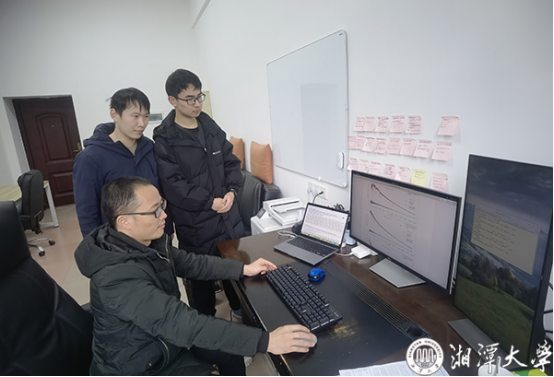
Basedon spectroscopic data from China’s LAMOST (Guoshoujing) telescope,togetherwith photometric and parallax data from ESA’s Gaia mission, the study discovered and identified 222 hot subdwarf stars,including 131 composite-spectrum hot subdwarfs.The researchers also identified a wide hot-subdwarf binary with the largest orbital eccentricity currently known, far exceeding the value predicted by theoretical models and posing a new challenge to existing formation models of hot subdwarf stars. Thisstudyrepresents an interim achievement in the search for special celestial objects using artificial intelligence methods and is an important demonstration of interdisciplinary collaboration between astrophysics and mathematics. Upon publication, the researchattracted attention from media outlets including CCTV News, Guangming Online, and the Global Times.

Hot subdwarf stars are a very special type of low-mass stars, with a mass of only about half that of the Sun, while their effective surface temperatures can reach four times that of the Sun. Hot subdwarf stars are of great significance for understanding frontier astrophysical issues such as the formation and evolution of low-mass stars, asteroseismology, and the diffusion process of elements inside stars. At present, there are more than 6,000 known hot subdwarf stars, the vast majority of which are identified through single-lined spectra; by contrast, hot subdwarfs identified through composite spectra remain very rare.
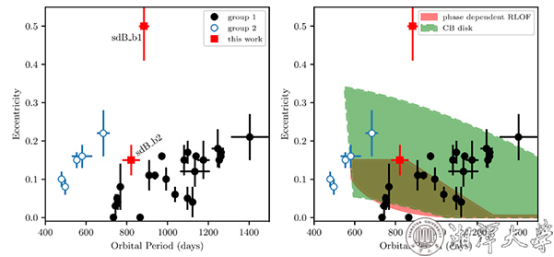
Period–eccentricity distribution of wide hot subdwarf binary systems
Astronomical Statistics and Big Data Applications is amajorsupportingdirectionof Xiangtan University’s world-class mathematics discipline. In recent years, the Hunan Provincial Key Laboratory of Stars and Interstellar Matter has focused closely on this direction, achieving a series of important results in areasincludingthe classification and characterization of celestial objects based on astronomical observational big data, simulation and computation of the properties of interstellar matter, astrophysical applications of magnetohydrodynamics, and time-domain studies of celestial objects.The teamhas published more than ten papers inleadinginternational astrophysics journals such asThe Astrophysical JournalandAstronomy & Astrophysics, and has undertaken a number of national-level projects, including the Excellent Young Scientists Fund of the National Natural Science Foundation of China, the Joint Research Fund for Space Telescopes, the Joint Fund for Astronomy, the General Program and Young Scientists Fund, as well as sub-projects of the Special Scientific Research Project for the Survey Space Telescope of the China Manned Space Engineering Program.

 Perspective Students
Current Students
Visitors
Staff
Alumni
Perspective Students
Current Students
Visitors
Staff
Alumni