Edited byLi Wenwen
Translated by Li Wenqiang, Huang Can
Source: School of Physics and Optoelectronic Engineering, Office of Science and Technology
Recently, Professor Yang Xuejuan from the School of Physics and Optoelectronic of Xiangtan University was invited to publish a News and Views commentary article entitledInterstellar dust revealed by light from cosmic dawninNature. Professor Yang Xuejuan is the first author of the article, with Xiangtan Universitylistedas the first affiliation.Dr. Li Aigen, Curators’ Distinguished Professor at the University of Missouri in the United States,is the second author.
The universe began with the Big Bang, then cooled as it expanded. Approximately 400,000 years later, the universe was composed primarily of hydrogen atoms, with no luminous celestial bodies, thus entering what is known as the Dark Ages. Around 400 million years later, the first generation of stars and galaxies formed, bringing the first light to the universe, marking thebeginningof the so-called Cosmic Dawn period, which lasted for approximately 600 million years.
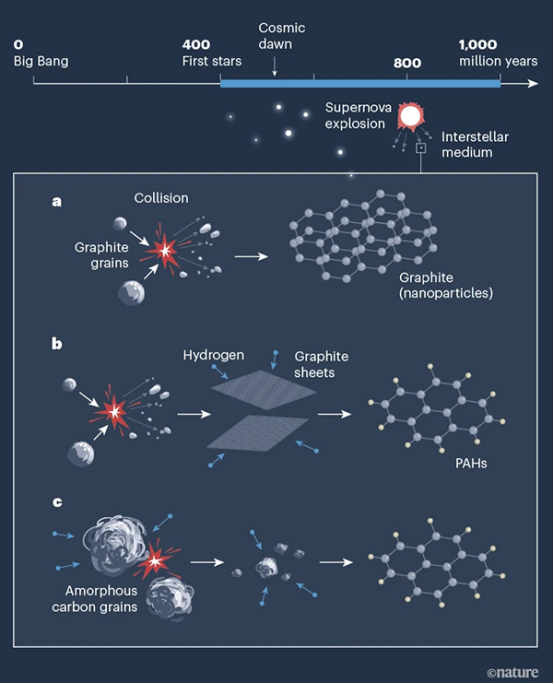
Figure 1:Professor Yang Xuejuan proposes that the 2175 Å extinction bump is produced by polycyclic aromatic hydrocarbons (PAHs), which originated from graphite or hydrogenated amorphous carbon (HAC) generated by supernova explosions during the Cosmic Dawn.
As the universe entered the Cosmic Dawn, where did dust come from? During this epoch, ordinarystars had not yet evolved to the stage of stellarwind mass loss, and thus could not produce dust. However, in a paper published in the same issueofNature, a team led by Dr. Joris Witstok from the University of Cambridge in the UK reported the detection of dust from the Cosmic Dawn. Using the James Webb Space Telescope, they detected light emitted 13 billion years ago from a distant galaxy, and found a significant dimming of light at the wavelength of 2175 Å, indicating that dust was already pervasive in the universe when it was only 800 million years old, during the Cosmic Dawn. For this reason, the journalNaturespecially invited Professor Yang Xuejuan and Professor Li Aigen to comment on and discuss the currently widely concerned topics of stellar evolution and dust origin in the Cosmic Dawn, and analyze the mechanism of light attenuation at the 2175 Å wavelength.

In recent years, Professor Yang Xuejuan and her team—including young faculty members Lin Qi and Li Qi, and doctoral student Wang Qian— have carried out a series of studies on the 2175 Å attenuation spectral feature of galaxies (commonly known as the extinction bump), and have made breakthroughs in using polycyclic aromatic hydrocarbons as the carrier of the 2175 Å extinction bump. Professor Yang Xuejuan proposed that the 2175 Å extinction bump in the Cosmic Dawn period is caused by the absorption of starlight by polycyclic aromatic hydrocarbons, which originated from carbon dust produced by supernova explosions. Although ordinary stars had not evolved sufficiently during the Cosmic Dawn, the progenitor stars of supernovae evolve very rapidly. These carbon dust grains form in the ejecta of supernovae, are ejected into interstellar space, fragment due to collisions, and eventually form polycyclic aromatic hydrocarbons under the action of hydrogen atoms. To test this hypothesis, Professor Yang Xuejuan pointed out that the James Webb Space Telescope should be able to detect the vibrational radiation of polycyclic aromatic hydrocarbons in the infrared band.
Professor Yang Xuejuan joined Xiangtan University after receiving her Ph.D.from Beijing Normal University in 2008. She has been engaged in interstellar aromatic hydrocarbon research since 2013, and has achieved a number of internationally recognized results. Many of her research findings have been included in textbooks, and she has delivered invited presentations at international conferences on many occasions. She has been featured in a special interview in the AstroPAH Spotlight column. Currently, she presides over projects including the Excellent Young Scientists Fund and Key Program of the National Natural Science Foundation of China.
Full text link:https://www.nature.com/articles/d41586-023-02766-4

 Perspective Students
Current Students
Visitors
Staff
Alumni
Perspective Students
Current Students
Visitors
Staff
Alumni