Written byKong Shuangxi
Edited byXiang Runyuan
Translated by Li Wenqiang, Huang Can
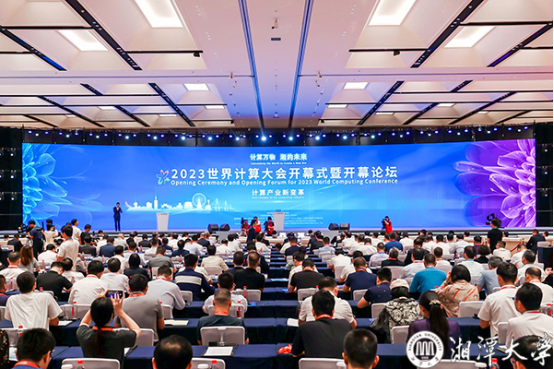
On September 15, the opening ceremony of the 2023 World Computing Conference was held at the Changsha Beichen International Conference Center, withXiangtan University servingas one of the co-organizers. On the morning of September 16, one of the conference’s featured events—the “Masters Forum on Applied Mathematics and Industrial Software”—was organized under the guidance of the conference organizing committee by Xiangtan University, Hunan National Center for Applied Mathematics, Hunan Shaofeng Institute of Applied Mathematics, and the Xiangtan Big Data and Industrial Innovation Development Center.
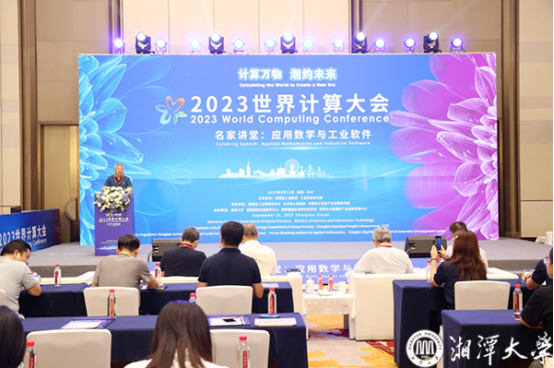
Liu Qijun, Secretary of the CPC Xiangtan University Committee, attended the World Computing Conference. Pan Biling, Vice Chairman of the CPPCC Hunan Provincial Committee and President of Xiangtan University, and Peng Jingdong, Second-level Inspector of the Hunan Provincial Department of Science and Technology, delivered opening speeches at the Celebrity Speech. Four invited guests delivered keynote presentations: Tan Jianrong,Memberof the Chinese Academy of Engineering and Qiushi Distinguished Professor of Zhejiang University; Li Ruo, Boya Distinguished Professor and Associate Dean of the School of Mathematical Sciences at Peking University; Jia Xiaohong, Researcher at the Academy of Mathematics and Systems Science, Chinese Academy of Sciences, and Deputy Director of the Computer Mathematics Committee of the Chinese Mathematical Society; and Fang Zhigang, Chief Expert of Huawei Cloud Industrial Software and CTO of Huawei Cloud Industrial Software. The forum was chaired by Huang Yunqing, Director of the Hunan National Center for Applied Mathematics.
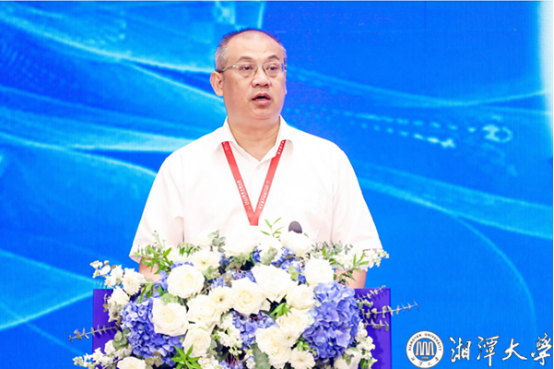
Pan Biling noted that given the current context, in which software has become a crucial driver of digital-twin development, the Applied Mathematics and Industrial Software Celebrity Speech, focusing on frontier areas and facilitating exchanges of collaborative experience, exemplifies the interplay between science and technology while highlighting the integration of theory and practice. He stated that the event would actively promote deeper exchanges and cooperation between academia and industry, effectively bridging the chains of education, talent, innovation, and industry.
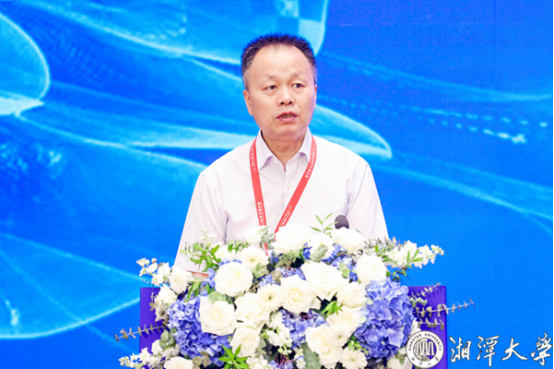
Peng Jingdong pointed out that mathematics, as the foundation of the natural sciences, is closely integrated with the promotion of industrial software, and that breakthroughs in the core technologies of industrial software urgently require the original thinking and foundational theories that mathematics provides. He added that the Celebrity Speech would further drive the deep integration of applied mathematics and industrial software, enhance the capacity of mathematics to support industrial development, and contribute to the high-quality development of technological innovation in Hunan.
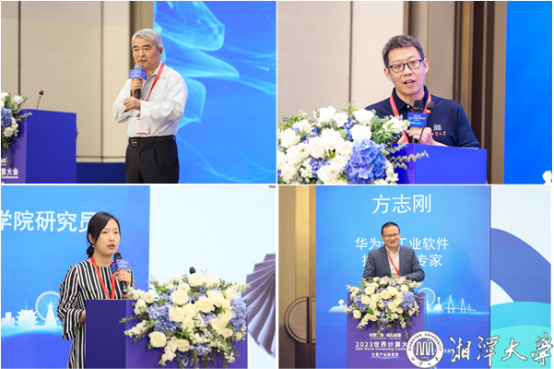
Tan Jianrong reviewed the development history of industrial software, detailing its basic characteristics, classification methods, and typical application scenarios. When discussing future trends in industrial software, he remarked, “Industrial software will no longer be just a tool; it will become the mainstay of future industry. I hope more mathematicians will engage in research on industrial software.”
Li Ruo gave a detailed introduction to Beitai Tianyuan, China’s first fully independently developed general-purpose numerical computing software. Focused on addressing “bottleneck” challenges in scientific computing, the software has achieved breakthroughs in core technologies for scientific computing kernels. Equipped with a powerful foundational mathematical function library, it supports scientific computing, visualization, interactive programming, and a wide range of disciplinary and industrial applications.
Using aero-engine turbines as an example, Jia Xiaohong explained the mathematical issues involved in various stages of CAX digital design and manufacturing, emphasizing the necessity of addressing the water-tightness problem caused by surface repair and intersection issues. She also summarized several typical algorithms for free-form surface intersection, existing technical difficulties, and topology-preserving intersection problems for free-form curves and surfaces.
Starting with Siemens industrial software, Fang Zhigang introduced advancements in the industrial software sector, explaining how cloud computing architectural innovations are reshaping the industrial software landscape. He identified five major investment opportunities in the DISA Alliance industrial software cloud platform: fundamental industrial software technologies, SaaS industrial software, scenario-specific SaaS toolchains, cloud factories, and engineering knowledge exchanges.
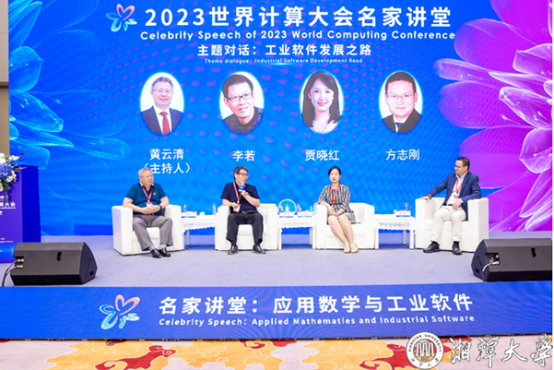
During the dialogue session of the Celebrity Speech, Huang Yunqing, along with panelists Li Ruo, Jia Xiaohong, and Fang Zhigang, shared their research experiences in applied mathematics and industrial software, with a particular focus on the Path to Industrial Software Development.
“Mathematics is a foundational discipline for industrial software development. Only with in-depth research on algorithms can we master the core of software and develop more practical applications,” said Wang Weijie, a graduate student from the School of Mathematics and Computational Science at Xiangtan University and a participant in the lecture. He noted that the experts’ reports emphasized the integration of academic research and practical application, deepening his understanding of the mathematics behind and application of industrial software.
Mathematics is one of Xiangtan University’s traditional strengths. In recent years, the discipline has received a series of national and provincial honors and has been selected as a discipline under China’s Double First-Class Initiative. The Hunan National Applied Mathematics Center, established in affiliation with the university, is one of the first 13 National Applied Mathematics Centers in China. The Center has produced a series of exemplary applications in advanced computing, intelligent navigation, intelligent manufacturing, construction machinery, deep-sea development, industrial software, and other industrial sectors. It has been designated as a Provincial Computational Power Landmark Engineering Algorithm Innovation Platform and a Provincial Digital New Infrastructure Landmark Project construction unit. In industrial software development and application, the Center has established highly productive collaborations with the China Academy of Engineering Physics, Pennsylvania State University (USA), the Academy of Mathematics and Systems Science, Chinese Academy of Sciences, Huawei, Hunan Jingyi Transmission Machinery Design Co., Ltd., and Xiangtan Iron and Steel Group Co., Ltd., among others. Its operational entity—the Hunan Shaofeng Institute for Applied Mathematics—has been recognized as a provincial-level new R&D institution and a provincial service provider for digital transformation in advanced manufacturing. Researchers at the Center have secured more than ten major projects, including National Key R&D Program projects and key projects of the National Natural Science Foundation of China, and have received nearly ten scientific and technological awards, including the Second Prize of the National Natural Science Award and the First Prize of the Hunan Provincial Natural Science Award.

 Perspective Students
Current Students
Visitors
Staff
Alumni
Perspective Students
Current Students
Visitors
Staff
Alumni