Written byWang Chengqi
Photos byWang Chengqi, Xiang Runyuan, Li Caiwei
Edited byLi Wenwen
Translated by Li Wenqiang, Huang Can
Source: News Center
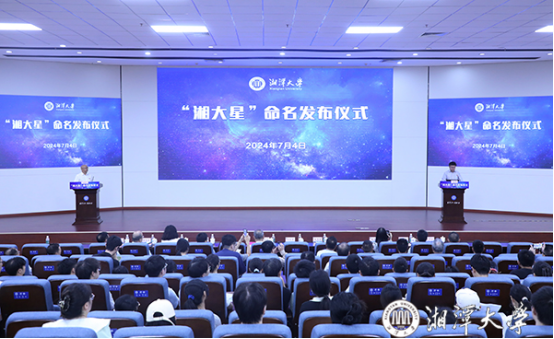
The starry sky has long carried endless dreams and hopes. On the morning of July 4, Xiangtan University held a ceremony for the official naming of the minor planet “Xiangda”(the Chinese abbreviation for Xiangtan University), becoming the first university in Hunan province to have an exclusive asteroid named after it. On the day of the ceremony, Xiangda Star was 300 million kilometers away from Earth.
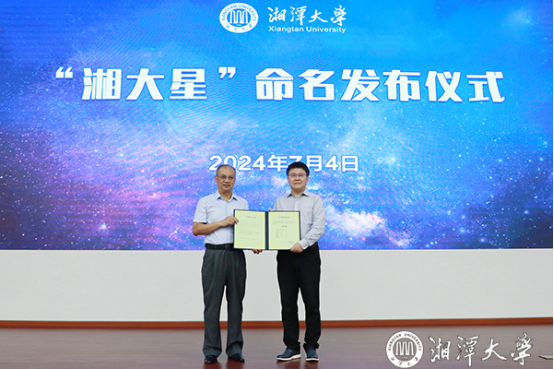
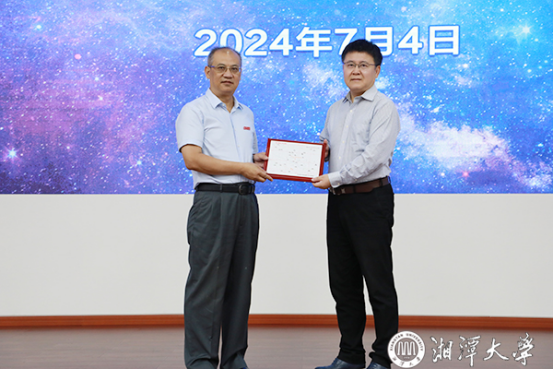
Liu Jifeng, Director and Deputy Secretary of the Party Committee of the National Astronomical Observatories, Chinese Academy of Sciences (NAOC), read out the international naming bulletin and naming certificate forthe minor planet“Xiangda”, and presented the naming bulletin, naming certificate, and orbital diagram of “Xiangda” to the university. This year marks the 50th anniversary of the reopening of Xiangtan University, and Pan Biling, President of Xiangtan University, accepted this special anniversary gift on behalf of all members of the Xiangtan University community.
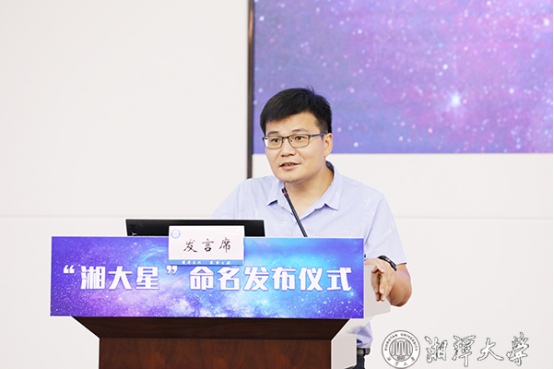
Zou Hu, Researcher at the NAOC, introduced the discovery process and relevant parameters of “Xiangda”. Wang Jiali, Senior Experimentalist at the NAOC, Xiao Zhiwei, Deputy Secretary of the Party Committee of Xiangtan University, Ge Fei, Vice President of Xiangtan University, Wang Jidong, Secretary of the University’s Commission for Discipline Inspection, and Deng Guojun, Liu Zhongwang, Vice Presidents of Xiangtan University, attended the ceremony, which was presided over by Xiao Zhiwei.
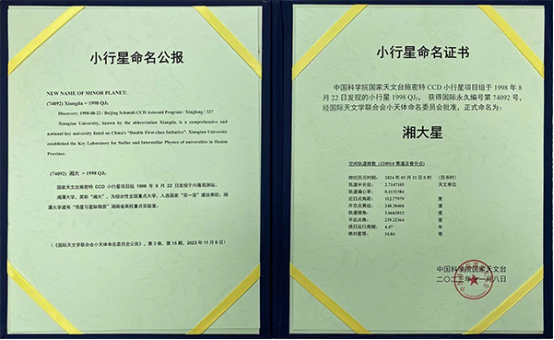
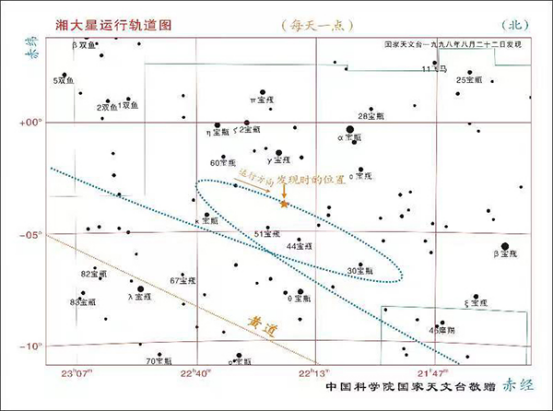
The nameof an asteroid is solemn, unique, and permanently unalterable, and receiving an asteroid naming is an internationally recognized, permanent, and prestigious honor. The asteroid, with the provisional designation 1998 QJ5, was discovered on August 22, 1998 by the Schmidt CCD Asteroid Program of the NAOC. Through a rigorous application and approval process, the asteroid was officially named “Xiangda”by the Working Group for Small Body Nomenclature (WGSBN) of the International Astronomical Union (IAU) on November 8, 2023, with the international permanent number 74092. Each digit of the number carries a special meaning.74 represents the year 1974, when Xiangtan University was reopened; 09 represents September 10, the founding anniversary of Xiangtan University;andthe number2 represents February 2022, when Xiangtan University was selected into the national Double First-Class initiative for higher education development.
“Xiangda” is located between Mars and Jupiter, with an orbital period of 4.47 years, an orbital eccentricity of 0.11, an orbital inclination of 3.67 degrees, and a semi-major axis of 2.71 astronomical units (AU). Its farthest distance from the Sun is 450 million kilometers, and its closest distance is 360 million kilometers, with an average distance of 400 million kilometers from the Sun. It completes one orbit around the Sun every 4.47 years, traveling at a high speed of 1.4 million kilometers per day, equivalent to 16 kilometers per second, along its orbit. The maximum distance between “Xiangda” and Earth is 600 million kilometers, while the minimum distance is only 210 million kilometers.
Over the 50 years since its reopening, Xiangtan University has achieved fruitful results in talent training, discipline development, and scientific research. In the field of astrophysics research, the university launched research on stellar evolution and stellar magnetic activity in the early 1990s. After more than 30 years of development, it has built a well-established academic research team with distinctive characteristics. Especially in recent years, the university has actively promoted the development of interdisciplinary subjects including mathematics, physics, astronomy, and space science, and defined astrological statistics and big data applications as a key discipline development direction. It has been approved to establish the Hunan Provincial University Key Laboratory of Stars and Interstellar Matter. Focusing on core research areas including interstellar medium physics, stellar and binary physics, and computational astrophysics, the team has achieved a series of important results in research fields such as classification and property research of celestial bodies based on big astronomical observation data, simulation calculation of interstellar matter properties, astrophysical applications of magnetohydrodynamics, and research on time-domain properties of celestial bodies. The team has published more than 100 papers in top international journals includingNature, and undertaken numerous national-level projects, including key programs of the National Natural Science Foundation of China (NSFC), the Excellent Young Scientists Fund of the NSFC, the Space Telescope Joint Fund, the Astronomy Joint Fund, and sub-projects of the special scientific research project of the China Manned Space Engineering Xuntian Space Telescope. The university has hosted high-level academic conferences including the 2022 SKA Pulsar Science Workshop, the 11th National Pulsar Symposium, and the 5th National Symposium on Interstellar Physics and Chemistry. In collaboration with the NAOC, the university has discovered and confirmed 222 hot subdwarf stars, including a wide-orbit hot subdwarf binary star with the highest eccentricity known to date, which far exceeds the predicted values of theoretical models. This research result has posed new challenges to the formation models of hot subdwarf stars, and generated favorable academic influence and social response.
At the ceremony, both the NAOC and Xiangtan University expressed their aspiration to establish an in-depth cooperative partnership and embark on a journey to the starry sea hand in hand.
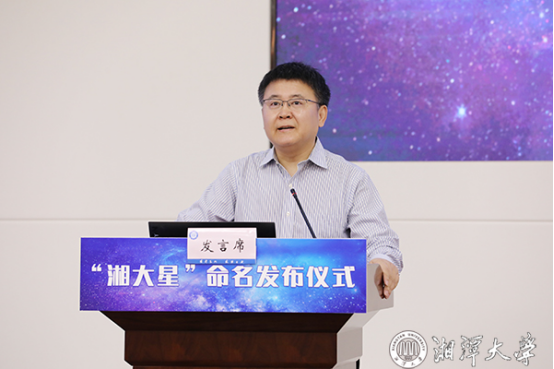
Liu Jifeng stated that naming the asteroid Xiangda Star fully demonstrates Xiangtan University’s outstanding contributions to higher education, scientific research, talent training, and social services, and reflects the high recognition of Xiangtan University’s educational achievements from the international academic community. The NAOC will work with Xiangtan University to advance the development of China's astronomy and big data industry, strive to build an influential scientific research team for astronomical big data, and make concerted efforts to promote the development of the country's astronomical cause.
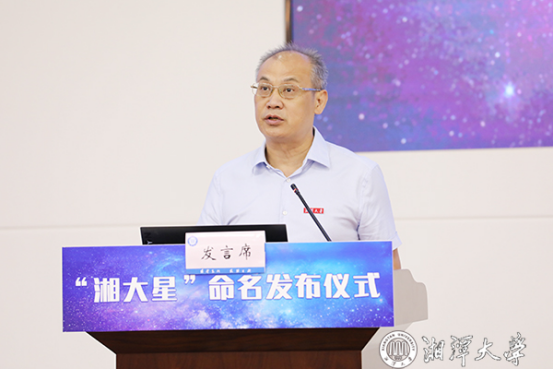
“The vast firmament stretches boundlessly, and people strive forward to unlock its mysteries. Exploring the universe has always been an unswerving dream of the Chinese nation.” said Pan Biling. He noted that the official naming of Xiangda Star, as the university celebrates the 50th anniversary of its reopening, will inspire all Xiangda people to unite as one and forge ahead with determination. Taking this opportunity, the university will further deepen its cooperation with the NAOC, strive to cultivate more outstanding talents, produce more first-class achievements, and make new and greater contributions to boosting the high-quality development of China’s astronomical cause.

 Perspective Students
Current Students
Visitors
Staff
Alumni
Perspective Students
Current Students
Visitors
Staff
Alumni